Variations in annual dengue intensities are explained by temperature anomalies
Our new work led by Abbey Porzucek, @rafalpx.bsky.social, @colincarlson.bsky.social, Dan Weinberger to develop a method to compare relative dengue intensity between years and countries.
www.medrxiv.org/content/10.6...
22.12.2025 23:37 — 👍 30 🔁 17 💬 1 📌 1

Graph showing temperature anomaly and other covariates' effects on "RISc" score globally and by region
NEW!🦠🌡️ : What makes a "dengue year" like 2023-24? It's hard to pin down an answer unless you can homogenize out all the spatial variation and temporal trends. But once you do, the answer is pretty clean: dengue years are hot years.
Last one of the year (unless...?) 👉 www.medrxiv.org/content/10.6...
23.12.2025 14:32 — 👍 26 🔁 12 💬 3 📌 0

Hi everyone,
I wanted to share some sad news about the future of the Verena program.
As you know, in September, NSF delayed our annual payment indefinitely, and asked us to keep spending closer and closer to zero until they could “justify” another payment. We began to run out of funds at some universities this month, and will be fully spent out by late spring, so the goal was to get paid in December. We’ve been working with our program officer to make this happen, but sadly, we’ve learned we’re not getting an increment again, and there’s no clarity on when or how much we will be paid in the remainder of the grant (through September 1, 2027).
Because of this, the Executive Committee has made the difficult decision to essentially shut the BII down until / unless something changes. What that means is an indefinite end to all programs (e.g., seminar), training activities (integration workshops, trainee corner), and evaluation. On research, what’s able to continue will have to be navigated by each investigator; our goal is to work together to push out all the impactful science we’ve spent three years collecting and analyzing data for, but we also know that priorities may shift around to keep people employed.
If we’re lucky, Congress will pass a budget that lets us continue doing something like what we planned, and we’ll pick that back up when Zoe and Collin are back in April. Until then, Verena will continue to exist as a community where we can collaborate (and give and receive support!), and we’re working to find funding sources that can pick up from where the BII left off.
On a personal note: it’s been the privilege of a lifetime to work with all of you, and an unbelievably lucky thing to get to run an NSF center in my 20s. I’ve loved this project, and I hope it’s made as much of a difference in your lives as it has in mine.
In case I don’t see you later: happy holidays, be well, and so long and thanks for all the viruses.
Best,
Colin
Yesterday, we sent this message to the @viralemergence.org team, bringing a (hopefully temporary) end to our project three years into what started as a decade of planned work. /1
05.12.2025 14:30 — 👍 214 🔁 114 💬 11 📌 14
Don't forget CDC TGS! BA.3.2 surveillance score is 3-0. Overall TGS 3 total: 1 from wastewater (which you mention linked) & 2 from asymptomatic traveler nasal swabs (GenBank: PV849885.1; PX641353.1) Earliest TGS from 6/2025.
bsky.app/profile/soli...
05.12.2025 00:02 — 👍 4 🔁 0 💬 1 📌 0

Real-time, multi-pathogen wastewater genomic surveillance with Freyja 2
Case-based infectious disease surveillance is fundamental to public health, but is resource-intensive, logistically complex, and prone to sampling bias. Wastewater testing and sequencing have increasi...
A few days ago we preprinted our Freyja 2 paper, describing the expansion of our original Freyja method to a real-time, multi-pathogen surveillance tool to track pathogen lineage prevalence and dynamics from sequencing of wastewater and other complex samples (like milk). 🧵
doi.org/10.1101/2025...
31.07.2025 19:16 — 👍 32 🔁 9 💬 1 📌 0
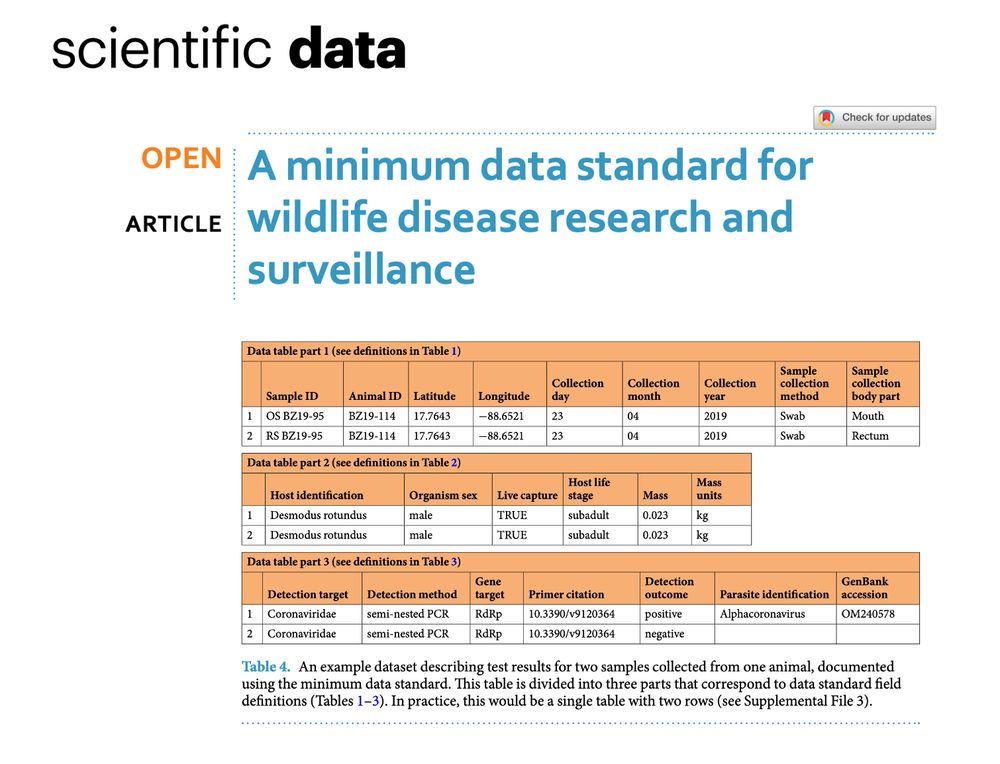
The title of the paper: "A minimum data standard for wildlife disease research and surveillance" - and an example data table
NEW! 🎉 We need wildlife disease surveillance to predict epidemics, but data sharing is rare - we found that only 2-3% of studies share raw data. So, we spent three years developing a data standard and R package to help get wildlife disease data into FAIR repositories. www.nature.com/articles/s41...
21.06.2025 15:17 — 👍 130 🔁 49 💬 3 📌 4
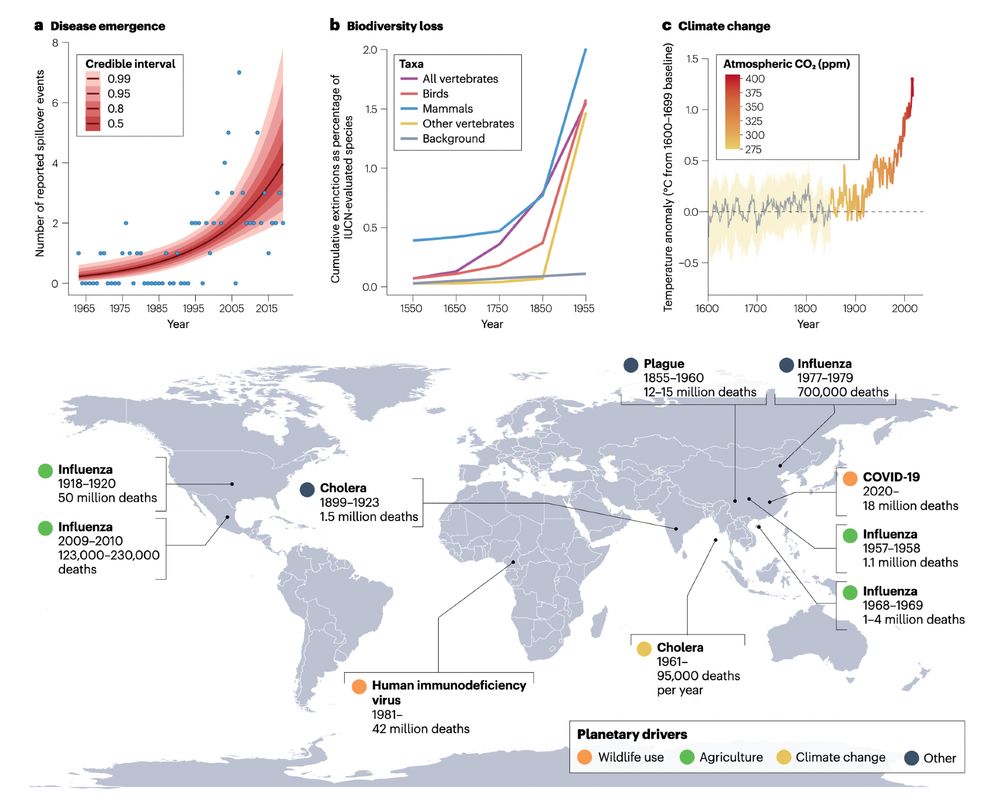
Top panels: graphs showing increases in spillover events, extinction rates, and temperature anomalies over the last few centuries. Bottom panel: a map of 10 pandemics since the year 1900. Four were linked to agriculture, two to wildlife use, and one to climate change.
🚨😷🧪 NEW: A growing body of evidence shows that pandemics, biodiversity loss, and climate change are part of a broader polycrisis - but there are no simple solutions. A sweeping overview of "Pathogens and planetary change" for the first issue of @natrevbiodiv.bsky.social, out now 🔓 rdcu.be/d6lHl
15.01.2025 14:16 — 👍 543 🔁 226 💬 17 📌 19
Almost certainly one of the ecologists of all time.
AI/ML, biodiversity monitoring, viral emergence, open science, methodological anarchism
he/they
🧪 https://epic-biodiversity.org/
🦠 Yale-based, NSF-funded Institute for pandemic prediction.
💻 How we do it: data, biology, AI, and team science.
⚖️ Why we do it: scientific discoveries and global health security.
➡️ See more at viralemergence.org.
I ♥ evolution, immunology, math, & computers. Professor at Fred Hutch & Investigator at HHMI. http://matsen.fredhutch.org/
Associate Prof at W.K. Kellogg Biological Station, MSU. Thinking about evolution and conservation in small populations. she/her 🏳️🌈
Assistant Professor at University of Michigan. Evolutionary biology, spatial population genetics, dad, he/him
Bioinformatics Scientist @theiagen.bsky.social
Likely swimming in a sea of pathogen genomes 🏊🧬 or riding my bike 🚴
Public Health | Infectious Diseases | Bioinformatics | Software Dev
We work on planetary problems. Currently: counting climate change-related deaths; pandemic risk assessment in a changing biosphere; data, science, and vaccine access during public health emergencies. 👉 carlsonlab.bio
Avian influenza & avian virome ecology | "Expert in Ducks" | (she/her) | michellewille.com
Virus spread and evolution + connection to behavior.
@Scripps Research, CA.
Dad, husband, President, citizen. barackobama.com
Scientist & Prof @UOxford
https://kraemerlab.com/
https://www.oxfordmartin.ox.ac.uk/pandemic-genomics
https://www.psi.ox.ac.uk/
Studying SARS-CoV-2 evolution @nextstrain @biozentrum
Studied Physics @Cambridge Uni, then learned about computers
PhD in Ecology from Penn State 🐸🎃🧬🔬🦠
I hang out with pumpkin toadlets and study the effects of climate change on amphibian skin microbiomes and disease.
Scientist+Engineer. Infectious disease modeler. Posts and spelling mistakes my own
A leading life science journal that champions high-impact research across all disciplines—from molecules to ecosystems. We offer innovative formats and collaborative editorial support to ensure your work achieves its full scientific impact.
Virologist. Evolutionary biologist.
Data Visualisation and Data Integration specialist - Melbourne, Australia
https://linktr.ee/mike_honey_
Support my projects by sponsoring me on Github: https://github.com/sponsors/Mike-Honey
Computational biologist & blogger