Another announcement! 📣 Our work on hybrid incompatibility in cohesin protection in 🐭oocytes is published!! Congrats Warif El Yakoubi and Eddie Pan!!🎉 We found hybrids with cohesion errors in two distinct genus.
www.science.org/doi/10.1126/...

@jsoro.bsky.social
https://orcid.org/0000-0003-3471-4637
Another announcement! 📣 Our work on hybrid incompatibility in cohesin protection in 🐭oocytes is published!! Congrats Warif El Yakoubi and Eddie Pan!!🎉 We found hybrids with cohesion errors in two distinct genus.
www.science.org/doi/10.1126/...
Not something you see in textbooks very often: tripolar mitosis.
07.02.2026 08:00 — 👍 1544 🔁 266 💬 49 📌 21
Our new preprint on SMCHD1! We’ve shown SMCHD1’s ATPase activity is critical for function in vivo, and excitingly a new DNA binding domain neighbouring the ATPase domain activates the enzymatic function, which is important for normal chromatin binding.
urldefense.com/v3/__https:/...

🧬🔬🎥 @science.org Live-cell single-molecule dynamics of eukaryotic RNA polymerase machineries | Science www.science.org/doi/10.1126/...
06.02.2026 00:14 — 👍 45 🔁 15 💬 0 📌 0Cognitive decline in aging parasitoid wasps https://www.biorxiv.org/content/10.64898/2026.02.03.703543v1
06.02.2026 00:45 — 👍 2 🔁 1 💬 0 📌 0I’m thrilled to share our latest preprint! Inspired by isothermal Gibson assembly cloning, we wondered whether we could assemble and integrate DNA sequences at a specific genomic locus in human cells. A thread (1/7) www.biorxiv.org/content/10.1...
17.06.2025 19:02 — 👍 6 🔁 1 💬 1 📌 2
Some (+)ve news to lighten another heavy weekend: our latest preprint (c/o Mattiroli + Ramani labs) is up!
www.biorxiv.org/content/10.1...
A tour-de-force by 1st authors Bruna Eckhardt & @palindromephd.bsky.social, focusing on chromatin replication. RTs welcome; tweetorial in 3,2...(1/n)

I’m thrilled to share my postdoc work and the first paper from the McKinley Lab! 🎉
@karalmckinley.bsky.social
We built the first transgenic model of menstruation in mice.
We used it to uncover how the endometrium organizes and sheds during menstruation. 🧪
www.biorxiv.org/content/10.1...
🧵
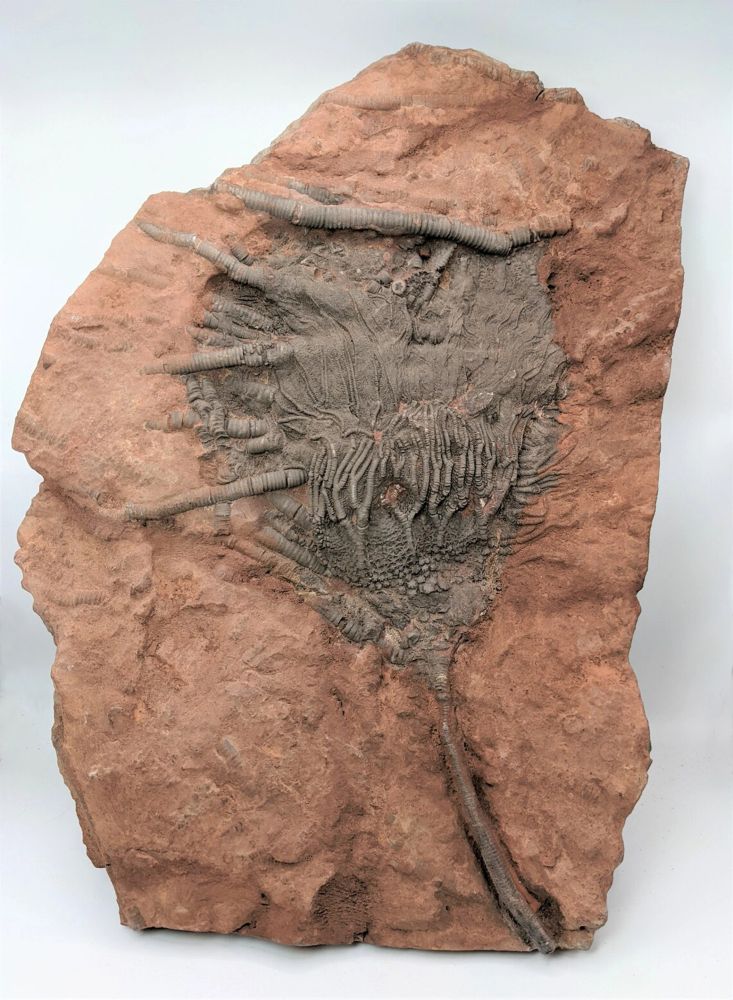
Millions of years ago during the Silurian period, the Sahara Desert was a shallow sea full of aquatic animals like crinoids. Don’t be fooled! Crinoids are commonly called "sea lilies" but they aren't plants! They are echinoderms, like starfish and sea urchins, and many species are still alive today!
Millions of years ago during the Silurian period, the Sahara Desert was a shallow sea full of aquatic animals like crinoids. Don’t be fooled! Crinoids are commonly called "sea lilies" but they aren't plants! They are echinoderms, like starfish and sea urchins, and many species are still alive today!
29.01.2026 19:59 — 👍 63 🔁 10 💬 0 📌 0Re-analysis of human population-scale whole genome seq data elucidates genetic architecture of EBV DNA persistence, a framework for the broader human virome
@nature.com @caleblareau.bsky.social @sherrynyeo.bsky.social @erinmayc.bsky.social @ryandhindsa.bsky.social
www.nature.com/articles/s41...

AlphaGenome is out in @nature.com today along with model weights! 🧬
📄 Paper: www.nature.com/articles/s41...
💻 Weights: github.com/google-deepm...
Getting here wasn’t a straight path. We discussed the story behind the model, paper & API in the following roundtable: youtu.be/V8lhUqKqzUc

Have you wondered how the rules of chromatin folding have evolved? Well, this task is not easy to formalize. But here is our take on it: train species-specific DNA-to-chromatin encoder, apply to DNA of unseen species, and build chromatin rules-based tree of life. Have a look:
doi.org/10.1093/nar/...
I’m happy to share the main result of my PhD, which you can find on bioRxiv www.biorxiv.org/content/10.6.... If you are interested in learning about a new way to perform DNA-PAINT multiplexing, which we call Combi-PAINT, or if you are interested in the study of mRNA conformation, keep reading! 1/10
26.01.2026 11:31 — 👍 74 🔁 26 💬 3 📌 5
screenshot of visualization from a weather site of projected snow and ice quantities. The ranges around 30 inches of snow and 0.5 inches of ice cover the same colors.
I love how this graphic is totally unhelpful for determining whether you're going to get 30 inches of snow or half an inch of ice.
23.01.2026 20:56 — 👍 4917 🔁 445 💬 373 📌 78Protein purification has been getting miniaturized! Hands on experience can be like doing a plasmid mini prep 😅
24.01.2026 15:16 — 👍 1 🔁 0 💬 1 📌 0I’ve actually gotten it down to midiprep-scale purification on the benchtop, just with magnetic StrepTactin or GFP nanobody resin (didn’t manage to squeeze that into the paper). Happy to talk more if you’d like to try it!
24.01.2026 15:10 — 👍 2 🔁 0 💬 1 📌 0Thanks Anton! Curious what you make of the ligation-gating model in the supplementary note.
24.01.2026 14:57 — 👍 0 🔁 0 💬 0 📌 0
I had the privilege to meet artist Mary Griffiths. Mary got inspired by Hi-C maps and over zooms we spoke about Hi-C maps, patterns and drawings. Mary’s Hi-C inspired art has been exhibited eg the Royal Academy. We wrote this piece about this art-science collaboration
pubs.aip.org/aip/bpr/arti...
Preprint alert: Jiangyuan Liu developed a new workflow for chromatin loop calling across Hi-C datasets, e.g., during differentiation. Most loops are shared between datasets/cell states. Important work for all interested in chromatin loops and how to identify them!
www.biorxiv.org/content/10.6...
Chromatin fatigue: DNA repair alters the chromatin environment and introduces heritable variation in gene expression in a larger region around the lesion! Amazing achievement by @sbantele.bsky.social and Jiri Lukas published in @science.org 🙌 Happy we could contribute. See 👇
12.11.2025 03:55 — 👍 38 🔁 10 💬 0 📌 0Preprint: doi.org/10.64898/202...
Huge thanks to the Risca Lab @riscalab.bsky.social and collaborators @laurenands.bsky.social @1001hak.bsky.social, @erichjarvis.bsky.social VGL 🙏
Also see independent CAD-C work in yeast from @axeldelamarre.bsky.social (Whitehouse lab, MSKCC).
16/16

At CTCF boundaries, walk polarity is asymmetric between flanking nucleosomes—biased toward the loop interior. Consistent with directional cohesin extrusion, resolved at nucleosome scale. CADwalks span sub-nucleosomal to chromosomal scales in a single assay.
15/

Analyzing fragment order in CADwalks, we find shuttling at long range – consecutive steps that venture out and back. Fragments making distal contacts are enriched for active regulatory chromatin. We also probe local fiber folding and nucleosomal footprints.
14/

This unlocks CADwalks: consecutive ligations between nucleosomal and sub-nucleosomal fragments, sequenced as intact concatemers. Each walk from a single nucleus. Reduced base-composition bias, no end repair.
13/

Because CAD-cleaved ends are natively ligatable, we can skip end repair and biotin entirely. Direct CAD-C does this and still yields high-quality maps. Native CAD ends ligate directly to each other.
12/

We call this ligation-gating. Capturing a loop requires both anchors in proximity AND both ligatable at once. CAD's ligation-competent ends raise this joint probability –consistent with both the loop sensitivity and the short-range enrichment. See Supplementary Note.
11/

But here's the puzzle: 1D ligation-junction coverage at loop anchors looks nearly identical between CAD-C and Micro-C. So why more loops? It's not about cutting more at accessible sites. It's about both anchors being simultaneously ligatable in the same cross-linked complex.
10/

CAD-C recapitulates compartments, TADs, & loops – w/ same or improved contrast. CAD-C-detected loops skew toward active chromatin; we see more TSS-anchored loops than Micro-C or Hi-C. CAD-C detects promoter loops to CRISPRi-validated enhancers that Micro-C misses at matched depth.
9/

We tested CAD-C in three human cell lines at saturating CAD concentrations. All worked on first try. Ligation efficiency was high, producing long concatemers.
8/

We optimized the CAD:ICAD construct for purification from E. coli and orthogonal activation by TEV protease. Result: consistent genome coverage across a 125-fold CAD concentration range.
7/