Happy to announce that I passed my PhD defence yesterday!!
Thanks to my supervisor @damonmatthews.bsky.social and the members of my examining committee — @nadinemengis.bsky.social, @gidden.bsky.social, Kirsten Zickfeld, and Sam Rowan

@mitchelldickau.bsky.social
Climate modelling. Temperature overshoot. Remaining carbon budgets. Temporary carbon storage. Effect of climate change on outdoor skating in Canada. Post-doctoral researcher, Concordia University
Happy to announce that I passed my PhD defence yesterday!!
Thanks to my supervisor @damonmatthews.bsky.social and the members of my examining committee — @nadinemengis.bsky.social, @gidden.bsky.social, Kirsten Zickfeld, and Sam Rowan
That's why carbon removal should be the last resort, not Plan A. Stopping the burning of fossil fuels must be the priority. Thanks to falling renewable costs, that’s getting easier every year
09.10.2025 19:53 — 👍 2 🔁 0 💬 0 📌 0I’m all for R&D and investment in carbon removal — it matters for hard-to-decarbonize sectors. But relying on it to offset avoidable fossil emissions doesn’t make sense when electrification and non-emitting electricity can eliminate most emissions far more affordably and at scale.
09.10.2025 19:53 — 👍 5 🔁 2 💬 1 📌 1
So, does it make sense to keep burning fossil fuels for power and then try to pull that CO₂ back out of the sky later?Not really. On average, renewables are already cheaper than fossil fuels – even if we don't include the cost of CO₂ removal.
09.10.2025 19:53 — 👍 0 🔁 0 💬 1 📌 0How many plants like one proposed in Manitoba would we need to offset even one quarter of global CO₂ emissions at today's rate of emission? ~20,000 plants.
That’s $10 trillion to build at the current price — not counting operating costs.
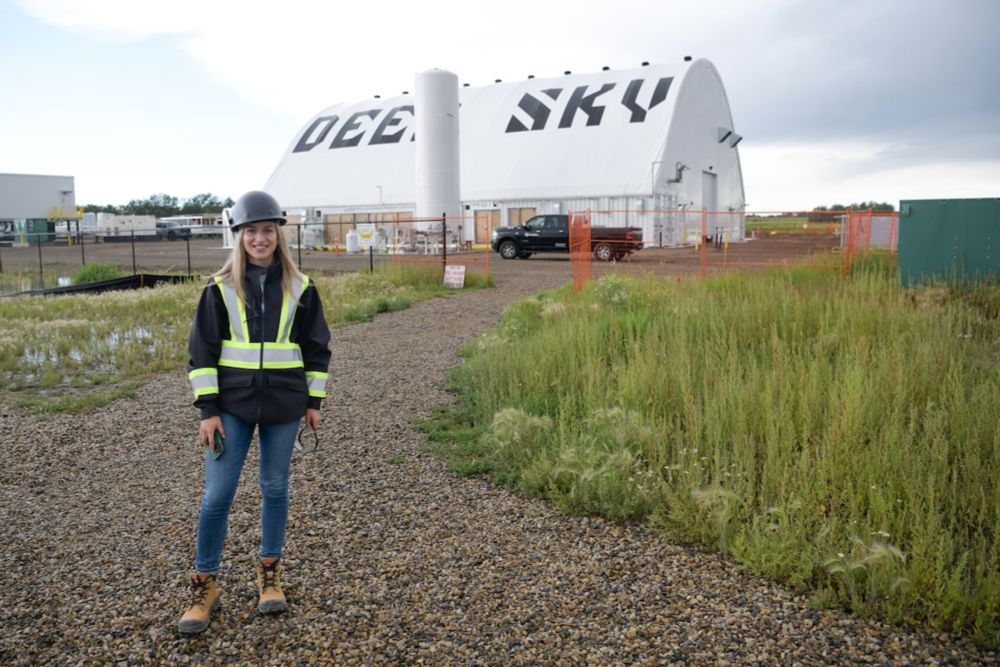
A new $500-million Deep Sky DAC plant is planned for Manitoba.
It’s designed to remove 500,000 tonnes of CO₂ per year — which equals just six and a half minutes of global emissions at today’s rate of emission

Direct air capture (DAC) is the only truly durable carbon removal tech we have right now.
The biggest DAC plant on Earth? It’ll capture just 900 tonnes of CO₂ (at $1000/tonne) in its first year of operation. That's less than 1 second worth of the 40 billion tonnes of CO₂ we emit each year.
Don’t let anyone fool you into thinking carbon dioxide removal is the solution to climate change.
It’s a small piece of the puzzle. But it won't be able to offset a substantial portion of our fossil fuel emissions 🧵
Thanks to my co-author @damonmatthews.bsky.social !
30.04.2025 07:39 — 👍 1 🔁 0 💬 0 📌 0Read the abstract here if you’re into the details:
🔗 doi.org/10.5194/egus...
More coming soon on this work!

For global temperature
✅ If we're rapidly cutting emissions, temporary CDR can help reduce peak warming.
⚠️ If emissions stay high past 2100, it only delays the heat—not avoids it.
Think reforestation that sequesters CO₂ now, but gets cut or burned later. Even though the carbon is re-emitted, we found there's still a benefit to temporary carbon storage —especially for slow climate responding variables like sea level rise.
30.04.2025 07:39 — 👍 0 🔁 0 💬 1 📌 0We looked at the climate impact of temporary carbon dioxide removal (CDR)—when carbon is captured but not stored forever.
30.04.2025 07:39 — 👍 0 🔁 0 💬 1 📌 0
Just presented some of my ongoing research at #EGU25 in Vienna!
A thread...
This difference in time horizons highlights why monitoring, reporting, and verification of land emissions and removals is essential, and why carbon markets must find robust methods to account for carbon losses due to disturbance.
22.04.2025 16:56 — 👍 0 🔁 0 💬 0 📌 0The timescale in which CO2 impacts temperature is 1000s of years. The longevity of nature based CDR is dynamically linked to climate and operates on much shorter timescales.
22.04.2025 16:56 — 👍 0 🔁 0 💬 1 📌 0The land sink is uncertain in a changing climate. This is another reason why using nature-based carbon dioxide removal (CDR) to offset fossil emissions can be sketchy...
22.04.2025 16:56 — 👍 0 🔁 0 💬 1 📌 0
We should point to the rising costs of insurance to demonstrate that climate change is dangerous and is worth mitigating against/ adapting to. I suspect that, for many folks, $$ is easier to understand than climate observations and projections.
Informative podcast on insurance and climate change
Hi Paul! I'm a student researcher with the ECCC CCCS for a bit over a year now. Could you add me to your list?
09.01.2025 15:10 — 👍 0 🔁 0 💬 1 📌 0Great reads. I've always believed that changes in the insurance industry are a powerful tool for driving momentum for climate policy. Unlike many other industries, private insurance can't afford to ignore climate impacts or delay action (state-run insurance is a bit different)
06.12.2024 16:33 — 👍 3 🔁 1 💬 1 📌 0But I am aware that we need to reduce our meat consumption and think it's an important part of climate mitigation. I just think there are important distinctions
04.12.2024 22:54 — 👍 3 🔁 0 💬 0 📌 0If you emit 100 Gt CO2e through raising cattle and then stop, the CO2 portion from LUC would be mostly reversed as the forest/grasslands regrow. The methane contribution to warming will also mostly be gone after 25 years.
04.12.2024 22:54 — 👍 3 🔁 0 💬 1 📌 0Well if we're trying to limit warming in the long term it matters. Let's say 100 Gt CO2 are emitted from coal and from raising cattle. For the 100 Gt CO2 from burning coal, the only way to truly reverse the warming effects in the long-term is using DACCS.
04.12.2024 22:54 — 👍 3 🔁 0 💬 1 📌 0It's 80x more powerful, but with a steady rate of emissions, the contribution to warming from CH4 is also mostly steady (perhaps a slight increase) because methane has a much shorter atmospheric lifetime.
04.12.2024 22:44 — 👍 0 🔁 0 💬 0 📌 0Any emission of CO₂ from coal contributes to warming.
Obviously we have to reduce beef consumption to meet Paris Agreement targets, and obviously lots of this info has been twisted by the beef industry, but it's important to recognize the differences between biogenic and fossil emissions
Because temperature contribution of anthropogenic CH4 mostly stabilizes when the rate of emission remains the same, cattle production could theoretically be close to neutral from a temperature standpoint if the number of cattle and and the amount of land being used both stay the same.
04.12.2024 22:43 — 👍 1 🔁 0 💬 1 📌 0I don't think it's totally fair to compare the two. Coal is fossil CO₂ being added to the fast responding part of the carbon cycle (land, surface ocean, atmosphere), and GHGs from cattle represent carbon that's already a part of the fast responding system.
04.12.2024 22:43 — 👍 3 🔁 0 💬 2 📌 0I couldn't agree more. When I taught an undergraduate class or when I've done different workshops/talks, I'm always surprised at the lack of understanding of how emissions contribute to warming. Perhaps a failure of the climate science community (or a success of the fossil fuel lobby)
04.12.2024 18:43 — 👍 1 🔁 0 💬 0 📌 0
3/3 Some other studies for those who are interested:
doi.org/10.1038/s432...
doi.org/10.1038/s415...
doi.org/10.1146/annu...

2/3 In 2022, we showed that temporary storage can still have a small climate benefit. However, since the warming effect of fossil CO₂ persists for 1000s of years, one tonne of CO₂ removed via nature-based solutions is very unlikely to offset the effect of one tonne of fossil CO₂.
02.12.2024 19:38 — 👍 22 🔁 6 💬 2 📌 0