The pace at which US wealth concentration is rising is simply staggering
The concentration of AI wealth into the hands of a few tech barons + plutocratic capture ==> unchartered territory

@samtl.bsky.social
Researcher Education & Vocational education & training, Swiss Coordination Centre for Reasearch in Education SCCRE/SKBF, @unibern.bsky.social
The pace at which US wealth concentration is rising is simply staggering
The concentration of AI wealth into the hands of a few tech barons + plutocratic capture ==> unchartered territory
Dual VET proves especially beneficial for men and individuals with low career motivation, indicating its effectiveness for those who struggle in a purely school-based system.
Full article here: authors.elsevier.com/a/1lqd6%7E1Q...
The results show that dual VET graduates secure their first #employment more quickly and experience far fewer periods of #NEET. In contrast, school-based VET graduates are more likely to pursue higher education, demonstrating that each form of VET has an advantage.
26.09.2025 16:21 — 👍 0 🔁 0 💬 1 📌 0The article looks at a key feature of vocational education and training ( #VET): firm-based training. To this end, I compare #dual ( #firm-based) VET with purely school-based VET, focusing on the #school-to-work transitions of Swiss VET graduates.
26.09.2025 16:21 — 👍 0 🔁 0 💬 1 📌 0
I am very happy that my article, «Classroom versus workbench: The impact of firm-based learning on labour market and educational outcomes » has been published in Economics of Education Review.
www.sciencedirect.com/science/arti...
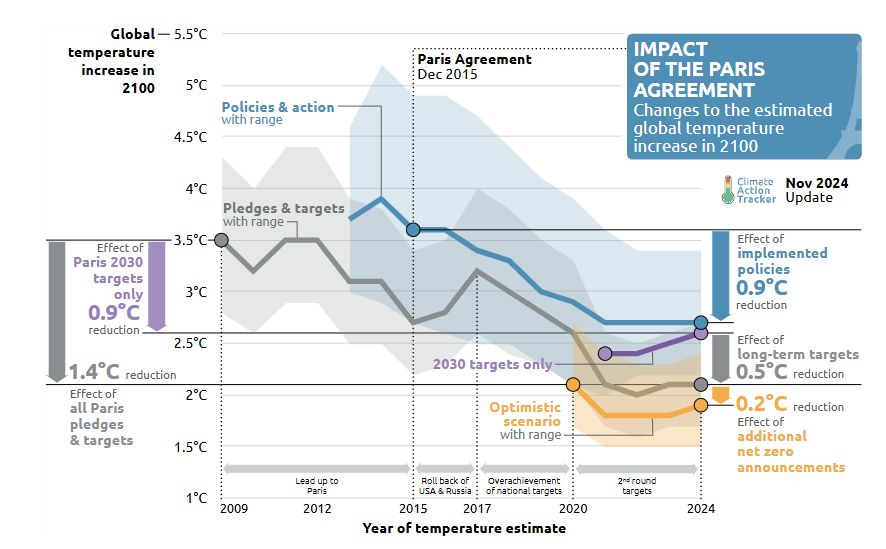
This is a great figure. For all the doom & gloom about climate inaction, we have made a big dent over the past 25 years.
What started out as 3.5-4°C increase by 2100 is now down to 2-3°C. Of course, more work is urgently needed but this is progress! We don't let up now. h/t @hausfath.bsky.social
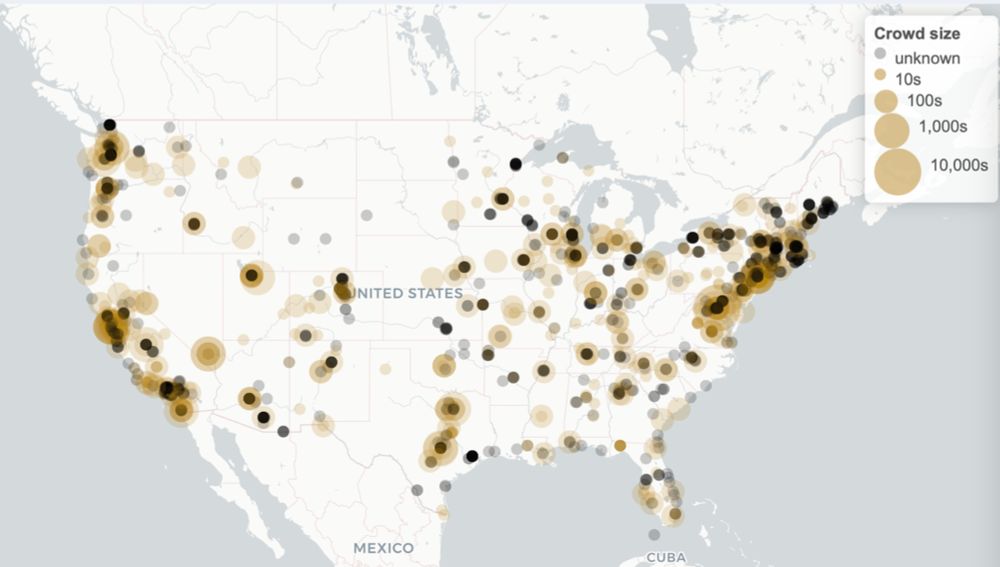
Thank you @rebeccasolnit.bsky.social & @chenoweth.bsky.social for this both insightful and inspiring interview on democratic resistance. 🙏 I needed that.
09.02.2025 15:18 — 👍 65 🔁 38 💬 5 📌 4This is a thread about remaking the tech sector.
06.01.2025 14:44 — 👍 204 🔁 78 💬 10 📌 22
"STEM intensity is an important determinant of earnings for many STEM & non-STEM majors, and estimated earnings gaps between pairs of majors can change dramatically when STEM intensity is accounted for...emphasize the value of STEM coursework for non-STEM majors" www.tandfonline.com/doi/full/10....
30.12.2024 12:24 — 👍 8 🔁 5 💬 1 📌 1Recently accepted by #QJE, “Cognitive Endurance as Human Capital,” by Brown(@clbrown.bsky.social), Kaur, Kingdon, and Schofield: doi.org/10.1093/qje/...
28.12.2024 12:00 — 👍 23 🔁 10 💬 0 📌 2
How do young people, the future workforce, respond to advances in GenAI? A Swissinfo article discusses our study findings:
www.swissinfo.ch/eng/science/...
Forthcoming in AEJ: Applied Economics: "Background Matters, but Not Whether Parents Are Immigrants: Outcomes of Children Born in Denmark" by Mathias Fjællegaard Jensen and Alan Manning. www.aeaweb.org/articles?id=...
19.12.2024 16:05 — 👍 14 🔁 3 💬 0 📌 0Moreover, the elasticity depends strongly on the regional and institutional setting. In rural areas, for example, education spending tends to be completely inelastic, raising both efficiency and equity issues.
12.11.2024 07:30 — 👍 1 🔁 0 💬 0 📌 0Maria Zumbuehl and I examine this response elasticity using #Swiss cantonal data. We find that expenditure responds rather loosely to changes in student numbers. Growing class sizes lead to lower per-pupil expenditure, while shrinking class sizes lead to higher per-pupil expenditure.
12.11.2024 07:30 — 👍 1 🔁 0 💬 1 📌 0
New publication in Education Economics on #school #finance.
School #cohort sizes vary from year to year, for example due to the ageing of society or due to immigration. But how do school #expenditures respond to these fluctuations?
www.tandfonline.com/doi/full/10....
👉 The results also show that dual VET is particularly helpful for men and for those with low career motivation.
12.11.2024 07:05 — 👍 1 🔁 0 💬 0 📌 0👉 The study's findings show that dual VET graduates are more likely to be employed after graduation, have higher incomes, and have fewer NEET periods, while school-based VET graduates are more likely to progress to higher education, but have significantly more NEET periods.
12.11.2024 07:05 — 👍 1 🔁 0 💬 1 📌 0The study analyzes the trajectories of Swiss VET graduates and investigates whether firm-based (dual) VET graduates and school-based VET graduates have different labor market outcomes.
12.11.2024 07:05 — 👍 0 🔁 0 💬 1 📌 0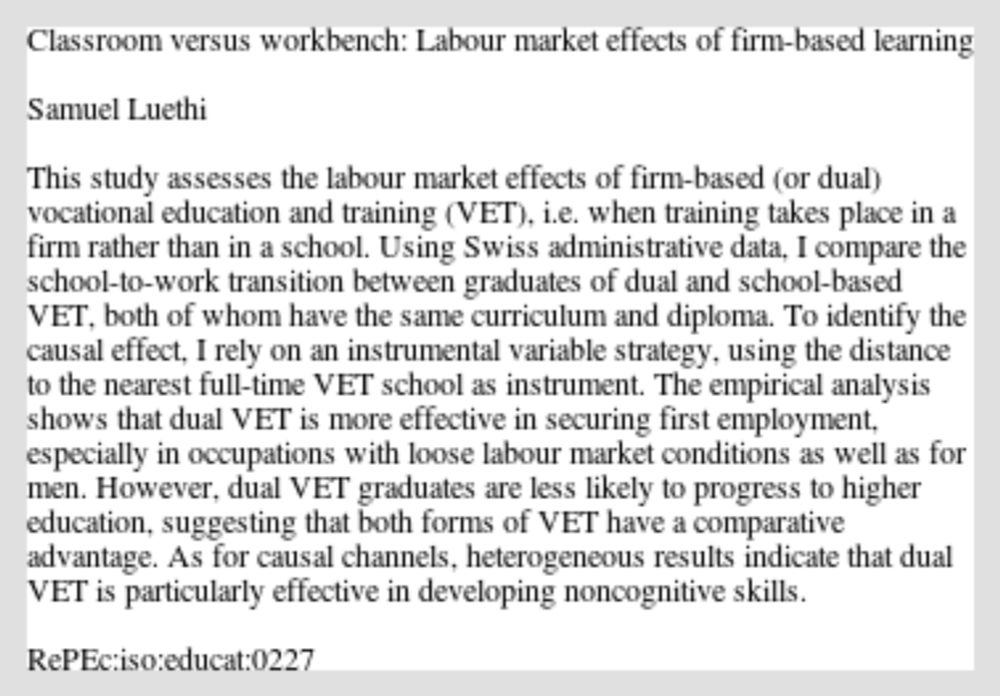
New working-paper 📈📉:
What is the role of firm-based training in the #school-to-work transition of #VET graduates?
ideas.repec.org/p/iso/educat...
Short 🧵:
Maria Alejandra Cattaneo uses Swiss survey data to investigate what factors drive wage expectations for persons with an academic background and vocational education. sjes.springeropen.com/articles/10....
@kaufmanndani.bsky.social @mariusbrulhart.bsky.social