Journal editors and publishers, do check out this course!
There are few, if any, quite like it; comprehensive, interactive and very practical.
06.02.2026 11:13 — 👍 1 🔁 0 💬 0 📌 0
Another interesting article of scientific and social advances from RBMO today!
Among other aspects, it touches on the way IVF technology is assisting space research, which in turn provides new information for IVF tech and treatments on Earth.
04.02.2026 20:51 — 👍 0 🔁 0 💬 0 📌 0
this is 100% right.
Glad to be seeing a lot more of these more sober sensible takes so far this year.
Now to go to LinkedIn to give this a bump there too, where it is even more sorely needed than here.
26.01.2026 10:54 — 👍 1 🔁 0 💬 0 📌 0
Insert *Pretends to be shocked* meme
17.01.2026 23:07 — 👍 0 🔁 0 💬 0 📌 0
It is baffling that anyone is still there. They should have all left years ago, when it was clear that staying on it was only support for it as a far right propaganda tool.
15.01.2026 10:44 — 👍 6 🔁 0 💬 0 📌 0
Discussing and applying are two entirely discrete actions, surely?
10.12.2025 16:32 — 👍 2 🔁 0 💬 0 📌 0
The galaxy brained understanderer had logged on
08.12.2025 22:57 — 👍 1 🔁 0 💬 0 📌 0
Adding this to my toolbar for quick reference. I don’t expect I’ll be the first to notice such things in any papers, but I’ll keep it to hand just in case.
02.12.2025 07:10 — 👍 2 🔁 0 💬 0 📌 0
It is very noticeable, and I do very much care.
You will lose my interest and confidence in a nanosecond.
28.11.2025 18:38 — 👍 6 🔁 1 💬 0 📌 0
Good to see this article has a cautionary note already. I expect it will be retracted in due course.
Shocking that this has made it to publication.
It does not help, of course, that publishers keep hemming and hawing around GenAI instead of shutting it down. Mixed messages only invite this stuff.
28.11.2025 15:03 — 👍 2 🔁 0 💬 0 📌 0
What a company.
This is indeed who you’re supporting when you use ChatGPT.
26.11.2025 17:52 — 👍 1 🔁 0 💬 0 📌 0

‘Token karaoke’ and ‘hobo tech’ are great
22.11.2025 18:08 — 👍 0 🔁 0 💬 0 📌 0
A lot of very useful and detailed resources for everyone from the novice to seasoned (and jaded) peer reviewer!
13.11.2025 12:12 — 👍 2 🔁 2 💬 0 📌 0

A table showing profit margins of major publishers. A snippet of text related to this table is below.
1. The four-fold drain
1.1 Money
Currently, academic publishing is dominated by profit-oriented, multinational companies for
whom scientific knowledge is a commodity to be sold back to the academic community who
created it. The dominant four are Elsevier, Springer Nature, Wiley and Taylor & Francis,
which collectively generated over US$7.1 billion in revenue from journal publishing in 2024
alone, and over US$12 billion in profits between 2019 and 2024 (Table 1A). Their profit
margins have always been over 30% in the last five years, and for the largest publisher
(Elsevier) always over 37%.
Against many comparators, across many sectors, scientific publishing is one of the most
consistently profitable industries (Table S1). These financial arrangements make a substantial
difference to science budgets. In 2024, 46% of Elsevier revenues and 53% of Taylor &
Francis revenues were generated in North America, meaning that North American
researchers were charged over US$2.27 billion by just two for-profit publishers. The
Canadian research councils and the US National Science Foundation were allocated US$9.3
billion in that year.

A figure detailing the drain on researcher time.
1. The four-fold drain
1.2 Time
The number of papers published each year is growing faster than the scientific workforce,
with the number of papers per researcher almost doubling between 1996 and 2022 (Figure
1A). This reflects the fact that publishers’ commercial desire to publish (sell) more material
has aligned well with the competitive prestige culture in which publications help secure jobs,
grants, promotions, and awards. To the extent that this growth is driven by a pressure for
profit, rather than scholarly imperatives, it distorts the way researchers spend their time.
The publishing system depends on unpaid reviewer labour, estimated to be over 130 million
unpaid hours annually in 2020 alone (9). Researchers have complained about the demands of
peer-review for decades, but the scale of the problem is now worse, with editors reporting
widespread difficulties recruiting reviewers. The growth in publications involves not only the
authors’ time, but that of academic editors and reviewers who are dealing with so many
review demands.
Even more seriously, the imperative to produce ever more articles reshapes the nature of
scientific inquiry. Evidence across multiple fields shows that more papers result in
‘ossification’, not new ideas (10). It may seem paradoxical that more papers can slow
progress until one considers how it affects researchers’ time. While rewards remain tied to
volume, prestige, and impact of publications, researchers will be nudged away from riskier,
local, interdisciplinary, and long-term work. The result is a treadmill of constant activity with
limited progress whereas core scholarly practices – such as reading, reflecting and engaging
with others’ contributions – is de-prioritized. What looks like productivity often masks
intellectual exhaustion built on a demoralizing, narrowing scientific vision.

A table of profit margins across industries. The section of text related to this table is below:
1. The four-fold drain
1.1 Money
Currently, academic publishing is dominated by profit-oriented, multinational companies for
whom scientific knowledge is a commodity to be sold back to the academic community who
created it. The dominant four are Elsevier, Springer Nature, Wiley and Taylor & Francis,
which collectively generated over US$7.1 billion in revenue from journal publishing in 2024
alone, and over US$12 billion in profits between 2019 and 2024 (Table 1A). Their profit
margins have always been over 30% in the last five years, and for the largest publisher
(Elsevier) always over 37%.
Against many comparators, across many sectors, scientific publishing is one of the most
consistently profitable industries (Table S1). These financial arrangements make a substantial
difference to science budgets. In 2024, 46% of Elsevier revenues and 53% of Taylor &
Francis revenues were generated in North America, meaning that North American
researchers were charged over US$2.27 billion by just two for-profit publishers. The
Canadian research councils and the US National Science Foundation were allocated US$9.3
billion in that year.

The costs of inaction are plain: wasted public funds, lost researcher time, compromised
scientific integrity and eroded public trust. Today, the system rewards commercial publishers
first, and science second. Without bold action from the funders we risk continuing to pour
resources into a system that prioritizes profit over the advancement of scientific knowledge.
We wrote the Strain on scientific publishing to highlight the problems of time & trust. With a fantastic group of co-authors, we present The Drain of Scientific Publishing:
a 🧵 1/n
Drain: arxiv.org/abs/2511.04820
Strain: direct.mit.edu/qss/article/...
Oligopoly: direct.mit.edu/qss/article/...
11.11.2025 11:52 — 👍 641 🔁 453 💬 8 📌 66

We are excited to reveal the first of our plans towards our next online conference.
Help us choose the theme for conference sessions by voting for your favorite from three shortlisted options suggested by our Council.
bit.ly/ease2026poll
10.11.2025 12:29 — 👍 2 🔁 1 💬 0 📌 0
A magnificent and most-needed paper
29.10.2025 17:44 — 👍 5 🔁 4 💬 0 📌 0
This survey will help us better understand
- global activity around board management,
- policies and processes for managing Ed Boards;
- public information on role profiles and requirements;
- regularity of performance reviews
and more
Please do take the time to provide your experiences
29.10.2025 15:13 — 👍 0 🔁 0 💬 0 📌 0
Catch up with the latest EASE news, valuable resources for Editors and Peer Reviewers, recent publications from European Science Editing and more, in the bi-monthly newsletter, EASE Update.
14.10.2025 10:03 — 👍 1 🔁 0 💬 0 📌 0
completely unacceptable to force people to click the thieving plagiarism slop box
But again, perhaps another signal from publishers their complaints about 'piracy' have not been serious all along, and everyone should be SciHubbing to their hearts content.
26.09.2025 10:44 — 👍 1 🔁 0 💬 0 📌 0
I do really like Zoom as a platform, but the recordings are getting increasingly worse for having out of sync audio and video. little slow-downs in the video make it impossible to correct, it's so weirdly warped.
It takes a lot of editing to cover over, and/or makes the recordings look so bad.
22.09.2025 14:22 — 👍 1 🔁 0 💬 0 📌 0
Calling all journal editors and managers interested in refreshing your strategies and updating approaches and skills to running your journals!
The EASE Editor School starts in 1st October with extremely insightful and experienced trainers who know their game
Full details in the link
👇🏽
19.09.2025 15:17 — 👍 1 🔁 0 💬 0 📌 0
YouTube video by Black Metal Promotion
Lamp of Murmuur - Forest of Hallucinations (Track Premiere)
New Lamp track just dropped.
Album of the year incoming, if you’re into grandiose Satyricon style epics of rabid animalism.
youtu.be/F8rcY_1d-mo?...
17.09.2025 18:23 — 👍 0 🔁 0 💬 1 📌 0
the first half about the reasons for growth of Reform is incisive.
not sure about the policy suggestions; and no mention of Starmer's freeport deals, selling the country into private caplitalist ownership, which drains money out, contradicts the positive spin on Reeve's economic strategy.
17.09.2025 11:57 — 👍 0 🔁 0 💬 0 📌 0
had the chance to get out my SpotOn conference peer review paddles for the webinar last night. Didn't quite make use of them as I had intended, but still they made an appearance!
webinar was great fun, and jam-packed full of information from all speakers. The recording will be up soon!
17.09.2025 09:34 — 👍 0 🔁 0 💬 0 📌 0
completely deranged.
17.09.2025 09:27 — 👍 0 🔁 0 💬 0 📌 0

RBMO Live is Live!
Feel free to jump in to our journal submission masterclass session!
Come join the editorial team of @rbmonline.bsky.social for some behind-the-scenes insights and advice into writing high impact articles, ai, peer review and science editing!
us02web.zoom.us/webinar/regi...
16.09.2025 19:12 — 👍 0 🔁 0 💬 0 📌 0
Looking forward to this webinar a lot!
It is open to anyone interested in submitting to top tier journals - especially in the IVF and fertility field, but not limited to those specialities.
Tuesday 16th September! My part is on peer review - in time for @peerreviewweek.bsky.social
10.09.2025 16:18 — 👍 2 🔁 0 💬 0 📌 0
any day now all those 2nd amendment advocates that freak out about stricter gun controls are going to show up to exercise the purpose of the clause...right?
any day now.
28.08.2025 11:30 — 👍 5 🔁 0 💬 0 📌 0
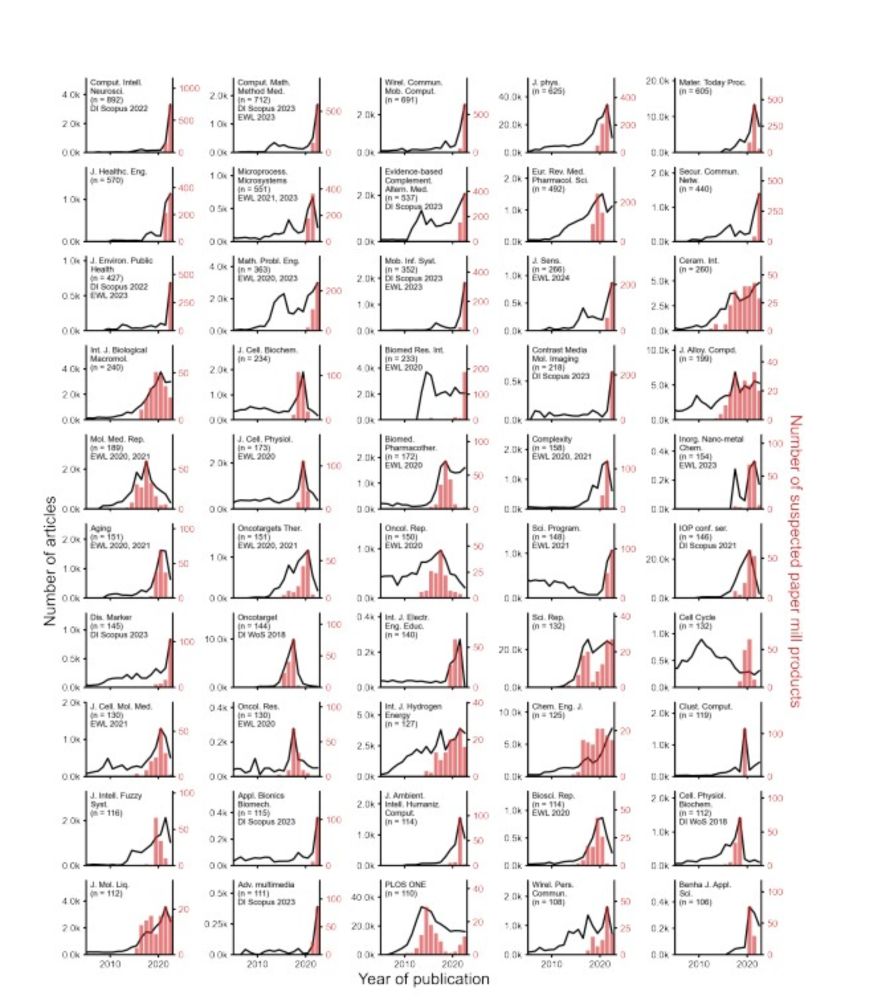
Fraudulent publication growth is outpacing legitimate science - EASE
A new study published in PNAS illustrates the scale of industrially-produced research papers from 'paper mills'.
New in the Bookshelf section of the EASE Digest blog, we share a new study published in PNAS which provides further insights into the scale of the industrially-produced research papers from ‘paper mills’.
@reeserichardson.bsky.social @jabyrnesci.bsky.social
ease.org.uk/2025/08/frau...
05.08.2025 11:53 — 👍 4 🔁 5 💬 0 📌 0
Yeah, it’s an entirely bad faith enterprise all the way through, which is why I’m surprised any serious organisation or person has entertained it.
Letting their doom in by the front door.
05.08.2025 11:02 — 👍 0 🔁 0 💬 0 📌 0
I used to scan brains, now I talk about science for a living. Science editor, science podcaster, SPIEGEL-bestselling writer. Founder of @realscientists.de and trainer at @nawik.de. Looks even worse IRL. He/him.
NEW BOOK IN MAY 2026
🔗 https://jensfoell.de
Professor of Computational Cognitive Science | @AI_Radboud | @Iris@scholar.social on 🦣 | http://cognitionandintractability.com | she/they 🏳️🌈
Lecturer in Critical Intersectional perspectives on AI at School of AI, Radboud University
Writer, artist, comic book creator. The October Girl (Book Two coming May 2026 from Mad Cave/Maverick), Amelia Shadows (Book One coming April 2026 from Papercutz), DC's Misfits of Magic, and others.
Literary agent: Moe Ferrara at TriadaUS.
Friendly, non-threatening rewriter of medieval history. Operates out of the Low Countries. Purveyor of Fine Puns.
An international partnership building open, community-governed systems and infrastructures to support open access book publishing.
Find us at https://www.copim.ac.uk/
#OAbooks
Green Party Leader (England & Wales)
London Assembly Member.
Chair of London's Fire Committee.
🏳️🌈
https://podcasts.apple.com/podcast/id1837201724?i=1000724643828
The Association of Learned and Professional Society Publishers - an International trade body which supports and represents not-for-profit organizations and institutions that publish scholarly and professional content.
Official account of the World Conference on #ResearchIntegrity
#WCRI2026
Vancouver, Canada
3-6 May 2026
https://wcri2026.org/
✒️ @gengyantang.bsky.social
Peer Review Week is a global event celebrating the essential role that peer review plays in maintaining scientific quality. On LinkedIn at http://bit.ly/PRWLink
https://peerreviewweek.net/
Editor in chief @ GEUS Bulletin (geusbulletin.org) - the diamond open access Earth Science journal published by the Geological Survey of Denmark & Greenland. Wildlife garden nerd. Lives in Denmark, via Australia & Cumbria. (cathjex.com)
Editor of Food Technology and Biotechnology journal, published by the University of Zagreb Faculty of Food Technology and Biotechnology. Vice President of EASE. President of CROASC (ZNAK).
Academic Research talks don't have to be shit!
✨ Researcher trainer
✨ Opinions about research culture
✨ Maker and fan of anything with dragons
Supporting phd's/ecrs/academics to do better more engaged and effective presentations
| He/Him
The official "Resistance" team of U.S. National Park Service. Our website: www.ourparks.org
#OpenScience advocate and communicator | Open Research at UKRI | Oxford, UK
(views my own)
Hopeless mitochondriak. Professor at McGill Neuro_MNI. Opinions my own.
Journal of Cell Science (JCS) publishes cutting-edge science encompassing all aspects of cell biology. JCS is a community journal published by The Company of Biologists (@biologists.bsky.social), a not-for-profit organisation. #cellbiology #cellbio
Providing information and advice about making your research open at the University of Sheffield.
We are unable to receive DMs. Contact us via links below:
https://www.sheffield.ac.uk/openresearch
https://www.sheffield.ac.uk/library/research
Cartoonist and Illustrator. My book of science cartoons, PHYSICS FOR CATS, is available now! www.tomgauld.com