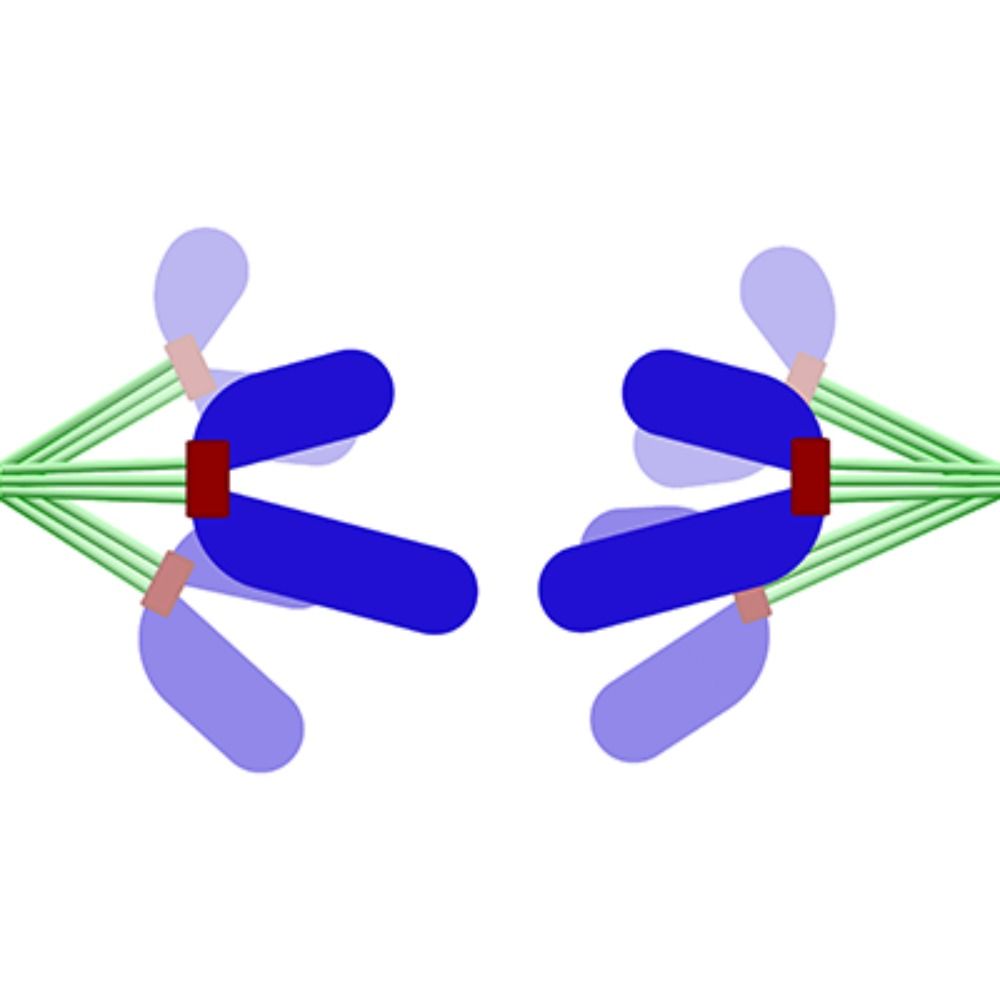
New preprint from our lab! Led by Emine Ali and @maxraas.bsky.social
See the highlights below!
01.12.2025 14:53 — 👍 6 🔁 1 💬 0 📌 0
Our story on the kinetochore composition of the ciliate Tetrahymena thermophila is out now on bioRxiv! We find surprisingly many orthologs of conventional kinetochore components, but also components that have very different evolutionary origins. A 🧵 (1/11)
Check it out here: tinyurl.com/4ectm9x4
01.12.2025 14:05 — 👍 24 🔁 10 💬 2 📌 2
Surprise — it wasn’t: RNA-seq and histology show that moderate/high CIN causes massive cell death, triggering regeneration without immune infiltration — providing the non–cell-autonomous push that fuels tumorigenesis. (5/5)
04.11.2025 11:41 — 👍 1 🔁 0 💬 1 📌 0
One possibility of such a mechanism: CIN may mimic TPA in promoting tumorigenesis. Indeed, moderate/high CIN could partially replace TPA in the DMBA/TPA regimen.
But what TPA effect was CIN mimicking? Inflammation? (4/5)
04.11.2025 11:41 — 👍 0 🔁 0 💬 1 📌 0
Now the twist: despite being induced under moderate/high CIN, these tumors are made of low CIN cells across other tumor types.
So what’s happening?
Moderate/high CIN drives the outgrowth of rare low-CIN tumor cells through a non–cell-autonomous mechanism which doesn't happen in only low CIN. (3/5)
04.11.2025 11:41 — 👍 1 🔁 0 💬 1 📌 0
CIN levels matter!
We used CiMKi mice to induce and monitor skin tumors across five CIN levels in combination with DMBA/TPA treatment.
Low → more tumors but no effect on onset or growth
Moderate → more tumors earlier onset and larger growth
High → fewer tumors but earlier and earlier growth (2/5)
04.11.2025 11:41 — 👍 1 🔁 1 💬 1 📌 0
Altogether, our findings highlight the need to explore the tissue context of p53 responses to aneuploidy. We propose that future efforts should integrate the use of appropriate models of diverse healthy and pre-cancer human tissues.
(8/8)
09.07.2025 10:32 — 👍 0 🔁 0 💬 0 📌 0
Finally, we show that losses, but not gains, are more universally linked with p53 deficiency across cancer types. This association has been previously made and highlights an exciting direction to explore the role of p53 responses to aneuploidy.
(7/8)
09.07.2025 10:32 — 👍 0 🔁 0 💬 1 📌 0
Surprisingly, we find that neither arm-level or whole-chromosome CNAs correlate with p53 deficiency. This is particularly interesting given the role of p53 in responding to DNA damage, which is often linked to arm-level copy number alterations.
(6/8)
09.07.2025 10:32 — 👍 0 🔁 0 💬 1 📌 0
This lead us to ask the following question: can specific features of aneuploidy better distinguish p53 proficient and deficient tumors? To explore this we focused on the type (arm- or whole-chromosome) and direction of copy-number alteration (CNA).
(5/8)
09.07.2025 10:32 — 👍 0 🔁 0 💬 1 📌 0
We were excited to find that p53 inactivation is neither sufficient nor necessary for tumors to accumulate a high degree of aneuploidy. We find that tumors with high aneuploidy yet intact p53 are common, and also that p53 inactivation does not invariably lead to highly aneuploid tumors.
(4/8)
09.07.2025 10:32 — 👍 1 🔁 0 💬 1 📌 0
To fully capture the p53 status we defined p53 deficiency as either TP53 mutations or alterations that phenocopy TP53 loss. Aneuploidy was defined as arm- or whole-chromosome copy number alterations (CNAs).
(3/8)
09.07.2025 10:32 — 👍 0 🔁 0 💬 1 📌 0
Despite decades of research, it is still unclear whether p53 protects against particular forms of copy number alterations and whether it does so universally across cancer types. To investigate this we systematically analyzed TCGA tumors across 31 cancer types.
(2/8)
09.07.2025 10:32 — 👍 0 🔁 0 💬 1 📌 0

A few weeks ago, we said goodbye to long-term Kops lab member Emine Ali, our resident protistologist.
We wish Emine all the best in her future career.
08.07.2025 13:35 — 👍 4 🔁 0 💬 0 📌 0

Spending a few days in beautiful Heidelberg for the 5th EMBL partnership conference. Our Hubrecht institute is EMBL partner and it has been wonderful to see the exciting science of the other partner institutes! @embl.org @hubrechtinstitute.bsky.social
02.04.2025 06:58 — 👍 9 🔁 1 💬 0 📌 0
An amazing inaugural Hubrecht Symposium on Developmental Biology, bringing the Dutch community together and getting inspired by amazing science! A big thank you to the speakers, the organizing committee and the many dedicated Hubrechters who made it happen.
25.03.2025 13:29 — 👍 2 🔁 0 💬 0 📌 0
🚀Ever wondered if there's a universal rule of spindle scaling across eukaryotes? Turns out, there is! Our study reveals an evolutionarily conserved principle driven by a surprising factor: chromosome crowding. 🧵👇
shorturl.at/MmPNr
10.03.2025 16:24 — 👍 18 🔁 5 💬 1 📌 1

Expression of the timing protein LIN-39 (green) in C. elegans
How do cells measure time? Despite its fundamental role in development, the underlying mechanisms remain unclear. An NWO ENW-XL grant allows a research consortium from the Hubrecht Institute, AMOLF, TU Delft, and ENS Paris to study timing regulation in C. elegans. www.hubrecht.eu/how-do-cells...
14.02.2025 09:11 — 👍 7 🔁 1 💬 0 📌 0
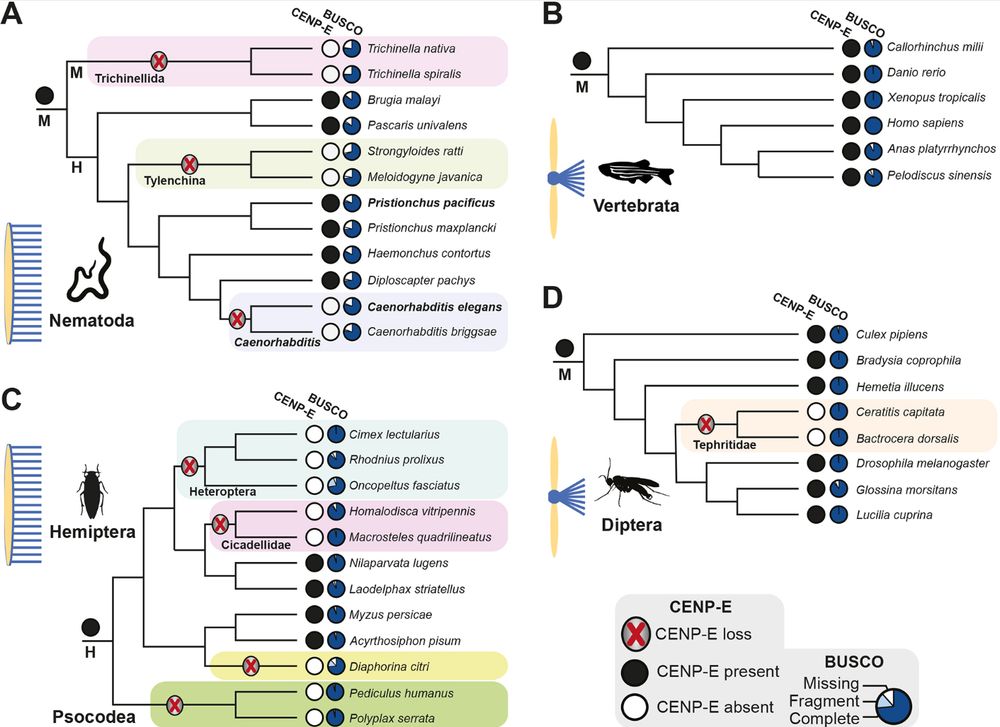
Phylogenetic profile of CENP-E across holocentric and monocentric taxa. (A–D) CENP-E conservation in (A) the phylum Nematoda, (B) the phylum Vertebrata, (C) the insect order Hemiptera and (D) the insect order Diptera. Lineages with an inferred CENP-E loss are highlighted with a coloured box. Holocentric lineages are indicated with ‘H’ and monocentric lineages with ‘M’, as well as with a graphic depiction of holocentric and monocentric chromosomes.
Ana Almeida, Helder Rocha, Maximilian Raas, Geert Kops, Reto Gassmann, Helder Maiato @i3suporto.bsky.social, et al. dissect the relationship between kinetochore size & CENP-E dependence for chromosome alignment.
journals.biologists.com/jcs/article/...
journals.biologists.com/jcs/article/...
09.01.2025 12:03 — 👍 6 🔁 4 💬 1 📌 0
Biologist @hubrechtinstitute.bsky.social interested in signalling dynamics, development, tissue homeostasis and microfluidics | Formerly MPI Biochemistry, Biocenter Basel and Embl Heidelberg | Mother of 2 | Posts are my own.
Utrecht | sonnenlab.org
Interim Director General EMBL. I have an insatiable love of biology. Consultant to ONT and Cantata (Dovetail)
Genome Integrity Lab | Children's Research Institute at UT Southwestern Medical Center. We study how chromosomes segregate, break, and rearrange.
www.thelylab.org
Contributing to a better world through research into the fundamental processes of living cells, tissues and organisms. The Hubrecht Institute is a research institute of KNAW and is affiliated with the UMC Utrecht.
Biophysics of mitosis / mitotic spindle / chromosome segregation and aneuploidy
Head of Laboratory of Cell Biophysics at @institutrb.bsky.social, previously at @mpi-cbg.de, LENS Florence, Niels Bohr Institute, @hsph.harvard.edu, Uni Zagreb.
tolic.irb.hr
Making Foundational Discoveries @fredhutch.org
fredhutch.org/basicsciences
Sir William Dunn School, University of Oxford, Interested in genome stability, homologous recombination, chromosome, centromeres
https://esashilab.wordpress.com/
Publishing reviews and commentaries across the fields of genetics and genomics. Part of Springer Nature and Nature Portfolio.
https://www.nature.com/nrg/
physician-scientist, author, editor
https://www.scripps.edu/faculty/topol/
Ground Truths https://erictopol.substack.com
SUPER AGERS https://www.simonandschuster.com/books/Super-Agers/Eric-Topol/9781668067666
Asst Professor, Dept of Biochemistry, Indian Institute of Science
Cell biology, Cytoskeleton, Cell cycle, Synthetic biology, Evolution.
Lab webpage: https://syncellbiolab.weebly.com
Alumnus of UniWarwick|DKFZ|MKU|VIT
NWO-Veni Fellow @GBB Rijksuniversiteit van Groningen | eukaryotic diversity | chromosome segregation | evolutionary cell biology | exploring meiosis
Cell Biologist excited about Chromosomes, Meiosis and Mitosis. Director, Wellcome Discovery Platform for Hidden Cell Biology
Structural cell biology @ University of Virginia Molecular Physiology and Biological Physics
Former @ Dept. of Biological Sciences & CBIS, NUS
anaphase.org
med.virginia.edu/faculty/faculty-listing/wwh6xu
mstdn.science/@MitosisLab
Assistant Professor | Laboratory of Microbiology | Wageningen University & Research
Evolution of genomes & protein complexes | eukaryotic origins & diversity.
Evolutionary Biologist at Stanford. Rapid Evolution, Adaptation, and Genomics. Open Science advocate.
Evolving better E. coli for 75,000 generations. Prof at MSU, but opinions my own. (Ok, I also speak for billions -- er, TRILLIONS -- of E. coli.)
Website for LTEE: the-ltee.org
Banner pic from NYC, shared by Darwin. (The microbiologist, not the other one.)
Study genetic conflicts professionally. Try to avoid conflicts in personal life (with mixed results).
Fred Hutch Basic Sciences,
UW Genome Sciences,
HHMI.
Posting in a personal capacity. My posts don’t reflect my employers’ opinions.
GBE publishes leading original research at the interface between evolutionary biology and genomics.
🔗 academic.oup.com/gbe
🏠 @official-smbe.bsky.social
🤝 @molbioevol.bsky.social
#genome #evolution #science #biology #societyjournal
Chief Science and Strategy Officer, openRxiv. Co-Founder, bioRxiv and medRxiv.
RCSB PDB (RCSB.org) promotes a structural view of biology. Funded by NSF, NCI, NIAID, NIGMS, NIH, and DOE