So does it exist in the end?
11.02.2026 10:34 — 👍 1 🔁 0 💬 1 📌 0
Beautiful work!
11.02.2026 07:02 — 👍 5 🔁 1 💬 1 📌 0

Banner image with screenshot of scientific article from nature Medicine, as well as two panels from the study method and results
⚠️ Despite all the hype, chatbots still make terrible doctors. Out today is the largest user study of language models for medical self-diagnosis. We found that chatbots provide inaccurate and inconsistent answers, and that people are better off using online searches or their own judgment.
09.02.2026 17:07 — 👍 345 🔁 161 💬 7 📌 33

Lowering the temperature allows transitions from the ‘sol-sol’ to the ‘sol-gel’ region, which manifest with a jump in the total volume fraction of the protein-rich phase.
The interplay between biomolecular assembly and phase separation.
🔗 buff.ly/lvTQhIM
09.02.2026 23:28 — 👍 11 🔁 4 💬 0 📌 0
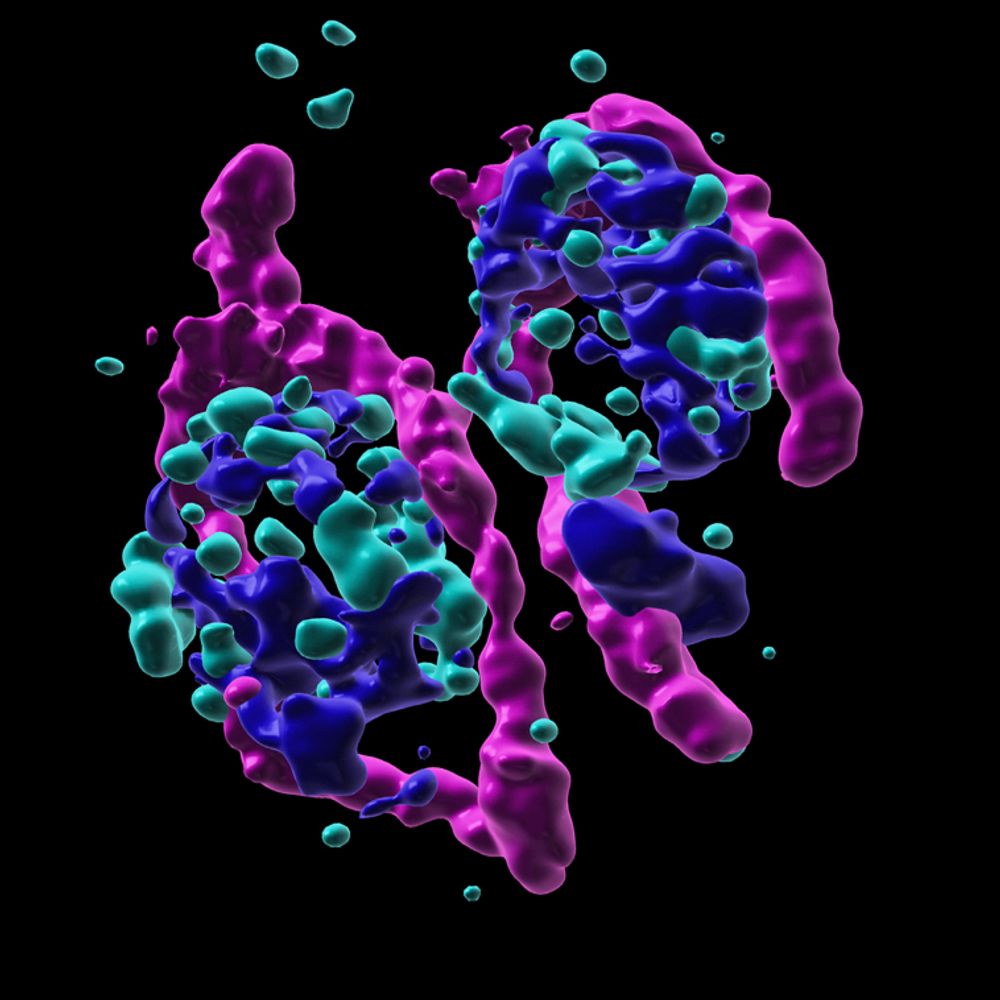
🧪🧬New preprint We present cryo-EM structures of reconstituted CTCF–nucleosome complexes, showing CTCF dimerization drives nucleosome oligomerization into defined higher-order assemblies. Disrupting CTCF–CTCF interfaces in mESCs reduces looping and impairs differentiation. tinyurl.com/CTCF-nucleos...
09.02.2026 12:54 — 👍 112 🔁 49 💬 4 📌 2


Finally, a detailed review about C-mannosylation: mechanism of C-mannosyltransferases and the influence of the C-mannosylation on the function of several proteins. Highly recommended to everyone in this type of post-translational modification!
tinyurl.com/3ywjmfk3
#glycotime
09.02.2026 10:43 — 👍 6 🔁 2 💬 0 📌 0
I also wondered if any of the dimerisation contacts are the same as in the crystal structures 8SSS, 8SSQ? It doesn't seem so, though.
09.02.2026 09:13 — 👍 0 🔁 0 💬 0 📌 0
This is stunning! Super work. Would it look the same regardless of linker DNA length?
09.02.2026 09:02 — 👍 4 🔁 0 💬 2 📌 0

Look at this 🙂 #CryoEM
Structural basis for CTCF-mediated chromatin organization by @lucas.farnunglab.com @voslab.org
www.biorxiv.org/content/10.6...
09.02.2026 08:32 — 👍 75 🔁 18 💬 4 📌 0

In memory of Professor Israel Silman (1935–2025)
Click on the article title to read more.
I was saddened to hear (with delay) of Israel Silman ('Sili')'s passing. A kind and very intelligent protein biochemist whom I was lucky to briefly work with.
07.02.2026 08:10 — 👍 7 🔁 1 💬 1 📌 0


A near-complete map of human cytosolic degrons and their relevance for disease
We measured degron potency of >200,000 30-residue tiles from >5,000 human proteins, and trained a model to predict degrons from sequence
Led by @vvouts.bsky.social in @rhp-lab.bsky.social
doi.org/10.1126/scia...
07.02.2026 07:41 — 👍 52 🔁 17 💬 0 📌 0

I am excited to share a new review @cp-molcell.bsky.social written in collaboration with @tanjamittag.bsky.social , Mikayla Eppert, and Ambuja Navalkar where we review the current evidence for and against the role of density transitions in regulating transcription www.cell.com/molecular-ce...
06.02.2026 21:20 — 👍 48 🔁 25 💬 1 📌 1

New preprint from the lab! We identify the ZnF protein Mulberry as a condensation-dependent structural regulator of genome topology that organizes “multi-way regulatory hubs” in early Drosophila embryos.
www.biorxiv.org/content/10.6...
05.02.2026 10:56 — 👍 38 🔁 16 💬 0 📌 0
Absolutely! - and all the insights into the usefulness of evolutionary couplings for structure determination, as well.
05.02.2026 09:54 — 👍 0 🔁 0 💬 0 📌 0
When certain patterns are implicitly present in large high-quality human data, one should not give too much credit to the machine learning algorithm that mines these data for patterns.
05.02.2026 09:28 — 👍 4 🔁 0 💬 1 📌 0
And AlphaFold was only possible because a huge number of experimental structures from which one could generalise was produced and catalogued by scientists over the years (and similarly for protein sequences used for MSAs).
05.02.2026 09:05 — 👍 11 🔁 2 💬 2 📌 0
(Because keeping it ontological can also prevent you from excluding any human who doesn't [yet] manifest a given quality in a way we want it to be manifestable, as I tried to argue under the previous post).
05.02.2026 08:55 — 👍 0 🔁 0 💬 0 📌 0
A part of it is whether the term is going to be demeaning/insulting. Even then, I can see the force of your objection, but I would still stand by the fact that keeping categories ontological and thus ammenable to being protected by the mimicry objection is a double-edged sword with a positive side.
05.02.2026 08:53 — 👍 0 🔁 0 💬 1 📌 0
I, personally, think that something that is more technical and focuses on operation would be better than any already widely used, 'casual' term. People do not object to 'efficient' or 'useful'. Perhaps one can say more than that, but in a similar vein.
05.02.2026 08:40 — 👍 0 🔁 0 💬 1 📌 0

This might be interesting:
05.02.2026 08:38 — 👍 0 🔁 0 💬 1 📌 0
Me later, 2011-2018. It would be easier to make everyone agree if we (or Turing) took a new term with less ontological and emotional baggage. I think you cannot just decide a term that is widely (and diversely) used to be easily definable.
05.02.2026 08:35 — 👍 1 🔁 0 💬 0 📌 0
One last thing I would add. We cannot escape the fact that our knowledge of humans (and perhaps other animals by extension) is largely through introspection. So it is not only the 'opaque' knowledge of how brain works. And we can have reasonable doubts this is extendable to LLMs.
05.02.2026 08:23 — 👍 0 🔁 0 💬 1 📌 0
(By the way, it seems we were both at the IMP at some point @giorgio.gilest.ro . Thanks for the discussion!)
05.02.2026 08:13 — 👍 0 🔁 0 💬 1 📌 0
My answer is in later posts, where I argue for the need to define this as an ontological capacity that might not be (yet) manifested - as in trainees, which is why they are trainees. Human beings developing in time is very different from a machine that you might want to benchmark at a specific point
05.02.2026 08:11 — 👍 0 🔁 0 💬 0 📌 0
I think freezing 'intelligence' as operational/measurable in any other way could be dangerous too, as is, in my view, extending it to machines that, as we know, were actually deliberately designed to mimic manifestation of intelligence without its ontological underpinnings.
05.02.2026 08:07 — 👍 0 🔁 0 💬 1 📌 0
... as there in principle rather than only when manifested, knowing that manifestation is contingent on lacks of obstacles and presence of supporting factors etc. The ellusive nature of the definition is a guardrail - just like any attempts to freeze it before ('IQ' etc.) had an effect of excluding.
05.02.2026 08:04 — 👍 0 🔁 0 💬 1 📌 0
And the Phillis Wheatley example is, I think, dangerous. Making certain commitments ontological might make them more difficult to extend - but it also prevents using them to exclude. I do think there is a certain robustness (and truth) in acknowledging a shared 'ontological' human capacity...
05.02.2026 08:02 — 👍 0 🔁 0 💬 1 📌 0
I think anyone trying using LLMs knows that a little 'push' in the right direction from a human operator at each step makes all the difference in almost any slightly more complex process - I don't think that's an illusion.
05.02.2026 07:56 — 👍 1 🔁 0 💬 2 📌 0
My counterargument would be that, perhaps, the moving goal post phenomenon is not dishonesty, but rather trying to name a certain reality that is difficult to put into words but is genuine, and is neither sentience nor consciousness per se, but is indeed about navigating intellectual questions.
05.02.2026 07:47 — 👍 2 🔁 0 💬 2 📌 0
Do you really don’t know?
(I’m a philosopher and historian of biology, interested in all things evolutionary, #genetic, or #cognitive. I find most things ridiculous.)
http://www.ehudlamm.com
Philosopher / Cognitive Scientist working on self consciousness and social interactions in humans and artificial agents/ Embodiment/ AI / Art & Science
In Lisbon & London
Research lab interested in #parasites #apicomplexa #toxoplasma #toxoplasmosis #plasmodium #malaria #mitochondria #cell-biology
https://lilachsheiner.wixsite.com/sheinerlab-wtcmp
Institute for Quantitative Biosciences, UTokyo. Mechanism of transcriptional regulation in the early embryo.
https://sites.google.com/view/fukaya-lab-iqb/home
Assistant Professor of Digital Humanities @camdighum.bsky.social. Florida man abroad, lapsed Catholic, vulgar marxist; phd'd Stanford English, alum of Literary Lab. I make data about culture and write about forms of abstraction in (C18) literary history.
Computational Biologist in the Narita Lab, CRUK CI and CRA at Homerton College, University of Cambridge. 🩷 🐈🐈⬛🧶🧮💻🧬🧪🧫🔭
Professor of Computational Cognitive Science | @AI_Radboud | @Iris@scholar.social on 🦣 | http://cognitionandintractability.com | she/they 🏳️🌈
Psychiatrist @ GHU Paris psychiatry and neurosciences
Research in computational cognitive science @computationalbrain.bsky.social
Seminar on Protein Structure Evolution every 2nd Tue, 4 PM GMT.
Link: https://tinyurl.com/prose-seminar2
By @claudiaalcar.bsky.social @caro-rocha.bsky.social @lacholt.bsky.social @zachary-ardern.bsky.social @romeritos.bsky.social @hassanzaman.bsky.social
I have a PhD in philosophy and now I work in a library. He/him.
michaelbenchcapon.blogspot.com
Professor, LSE. Philosophy of science, animal consciousness, animal ethics. Director of The Jeremy Coller Centre for Animal Sentience.
Assistant Professor at University of Utah studying host-virus interactions
http://hobbs.biochem.utah.edu/
Scientist in transit. Meet me @College-de-France Paris🇪🇺 or @Arolla🇨🇭#InHoxWeTrust #GesamtNaturWerk. Et Ce Fut Tout.
Museum exec, MRC, visiting prof at the Dunn School, Oxford, and UCL Chemistry. Ex Editor of New Scientist, and Science Editor of the Telegraph. Co-author #VirtualYou and more books. Neutron bouncer
#chemist at A*STAR Singapore | previously a Pharmacy graduate
#preLighter at #preLights
Views my own
Like =/= endorse
Professor studying the interplay between DNA damage and human health. WY➡️CSU➡️UI➡️NIEHS➡️KU. Personal posts from science to society.
Postdoc in the Meissner lab at the Institute for Innate Immunity in Bonn. Previously DTU Bioengineering. Interested in innate immune signaling with a focus on ubiquitin and other post-translational modifications.