It takes the top spot, mounted on the wall by my desk.
I think it looks klaas,
Thanks!

@petedyson.bsky.social
Behavioural science & transport University of Bath. Bicycle Mayor of Bath. Co-author 'Transport for Humans' http://amz.run/52F9
It takes the top spot, mounted on the wall by my desk.
I think it looks klaas,
Thanks!

I led this! Please read news on "The Bristol Declaration" = massive transport + health impact. www.fph.org.uk/news/bristol...
Thanks @fphuk.bsky.social @rsph.bsky.social @transporthealth.bsky.social @ianwalker.bsky.social @drjomaher.bsky.social Please share! @livingstreets.bsky.social
Yes
10.12.2025 21:02 — 👍 0 🔁 0 💬 0 📌 0
I’m very proud to have been part of this report with @pactsuk.bsky.social and @sarahcoombesmp.bsky.social on the serious and growing problem of Ghost Plates. The past couple of months have been incredibly eye-opening, to say the least: transportsafetyappg.org.uk/inquiries/ve...
09.12.2025 09:49 — 👍 69 🔁 26 💬 3 📌 3Updated based on today's Budget. I explain how the charge 'splits the difference', it is consistent (not confusing) to offer a grant while also introducing a fee to balance cost of usage, and how it has opened the door to increasing fuel duty in 2026.
www.linkedin.com/pulse/3p-per...

Here's my analysis of the 3p-per-mile EV charge, already proposed ahead next week's UK budget. The policy has strengths of simplicity and fairness, two countries already do it, so I review the potential debate around charging equity and vehicle efficiency. www.linkedin.com/pulse/3p-per...
18.11.2025 17:25 — 👍 4 🔁 1 💬 0 📌 1Nice! Such an ensemble cast of researchers from UK and Europe :)
BTW, I believe the URL is missing a '3' at the end.
This link works for me:
doi.org/10.1016/j.jc...
Whereas the one above does not: doi.org/10.1016/j.jc...
Nice, will be useful. Wherever I go in the UK, I always seem to end up at the nearest canal or railway path.
Putting old infrastructure to new use (though not sure if the Victorians would be impressed, disappointed or ambivalent!)
Yes, I see gauge-changing train is mentioned, seems like you're not optimistic.
30.09.2025 16:23 — 👍 0 🔁 0 💬 2 📌 0
youtu.be/zGz22MHMvj8?... Like the Swiss trains, is this technology suitable for any of the countries you mention? Or too niche?
30.09.2025 10:48 — 👍 2 🔁 0 💬 2 📌 0
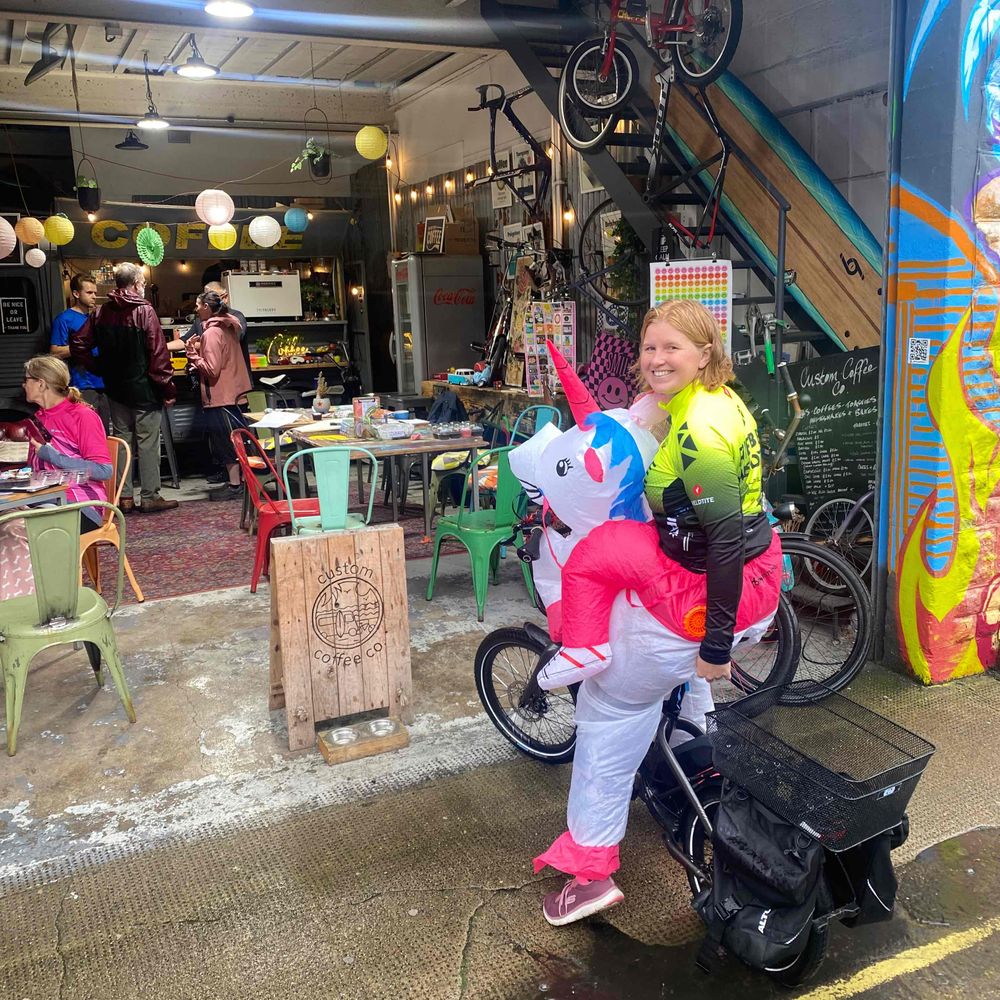
Girl riding in group of people in Bath
Bath’s streets are better when filled with bikes and laughter! 🚲🥳
Join our next Kidical Mass family cycle ride at 2pm on Sat (13 September) - starting at Orange Grove.
www.facebook.com/events/79625...
Yes true, just giving the HS leg as an example.
Based on my TGV window gazing through France, I would say a high speed view is different, in some ways better, than a typical speed train because the landscape changes even more. Wonder if TGV or other HS operators have done any research?
Interesting, though from the London-Birmingham leg I've heard the statistic (repeated on R4) that across the ~60min journey only 10mins will have a view (that isn't tunnel/steep banks/sound insulation walls).
So perhaps there's an extra challenge to be solved, giving people something to look at?

We should ask the great Gino D'Acompo for his view on the bus tram... youtu.be/A-RfHC91Ewc?...
26.07.2025 11:54 — 👍 2 🔁 0 💬 0 📌 0@tomhainesdoran.bsky.social
25.07.2025 16:04 — 👍 1 🔁 0 💬 0 📌 0Indeed, in addition to a crude ratio, widening the distribution of chargers to more places important. Also, as numbers increase there's less chance of having zero chargers available (e.g. a car park with just one or two chargers is more likely to be 100% occupied).
25.07.2025 15:51 — 👍 1 🔁 0 💬 1 📌 0
This is welcome news for EV transition, but the ratio of EVs to chargers is a key metric for prospective owners. In the UK, the number of EV is also increasing fast (in 2025, roughly +450,000 which is +33% YoY), so I made to chart to show ratio over time. www.transportxtra.com/publications...
25.07.2025 10:53 — 👍 4 🔁 0 💬 1 📌 0And welcome to transport studies Jason Frerich!
The paper author appears to be a spinal surgeon (based on previous articles) and supervised by @casssunstein.bsky.social on this research. Explains the walking example being in Boston.

Nice spot. I long for the day our journey planners are tweaked to sustainable defaults and customisable by the user.
Two extra interesting points (1) the walk default also boosted to cycling (2) the health and norms messaging didn't budge driving choice when driving was the default.

Nice! And part of that investment was bus stop infrastructure and real time information, which is ongoing. I think the gains will be additive. www.bbc.co.uk/news/article... @bettertransport.bsky.social
15.07.2025 13:12 — 👍 4 🔁 1 💬 0 📌 0Interesting article, though it doesn't explore fear or the Goodwin Curve. It looks at support and perceived fairness.
Separately, a shame sampling on Exp1 (speed) + 2 (road pricing) are so underpowered and skewed (no power calc or acknowledgment as a limitation). Exp 3 on train tickets is better.
@gideonsalutin.bsky.social is the report available? Looks pretty technical on the secondary data analysis of NTS, I'd like to read.
08.07.2025 16:19 — 👍 0 🔁 0 💬 0 📌 0Looks interesting, but frustrating the Guardian report on the findings without the report being available to read. I've looked on SMF and can't find.
07.07.2025 08:37 — 👍 2 🔁 0 💬 1 📌 0It's also an uncomfortable truth that, if people knew the harms of noise, they'd be more vocal and supportive of action. But, like air pollution, there is a process of acceptance to acknowledge your life (and your love ones) has been harmed. I say that as a busy road dweller of 15yrs and counting.
25.06.2025 10:40 — 👍 4 🔁 0 💬 0 📌 0Indeed, less discussed among policymakers and politicians, but common place in day-to-day frustrations (when an obscenely loud vehicle passes by) and bigger life choices (like where to live).
Sustainable transport sorely needs more widely popular policies, designing/regulating/policing noise 👍

One of the less discussed impacts of transport.
“Noise pollution is often overlooked, considered just an annoyance of everyday life. However, long-term impacts of noise on our health and environment are widespread and significant. Children are also particularly vulnerable to the effects of noise…”
Bikes go a long way, if our minds and bodies let them 😀. Cycling non stop from London to Edinburgh in 17hrs was a personal challenge, also fundraising for a local charity. In this case not a scalable mode of transport, but shows what's possible at a human scale! 🚲 🏴 🏴 ☀️ share.google/ybbfT4KMW1Zz...
17.06.2025 09:15 — 👍 9 🔁 2 💬 0 📌 0I discussed developments in cycling safety and active travel more generally. Thanks to RWK Goodman for hosting us: a barrister, a lawyer and a BYCS bicycle mayor for Bath :)
05.06.2025 08:58 — 👍 4 🔁 0 💬 0 📌 0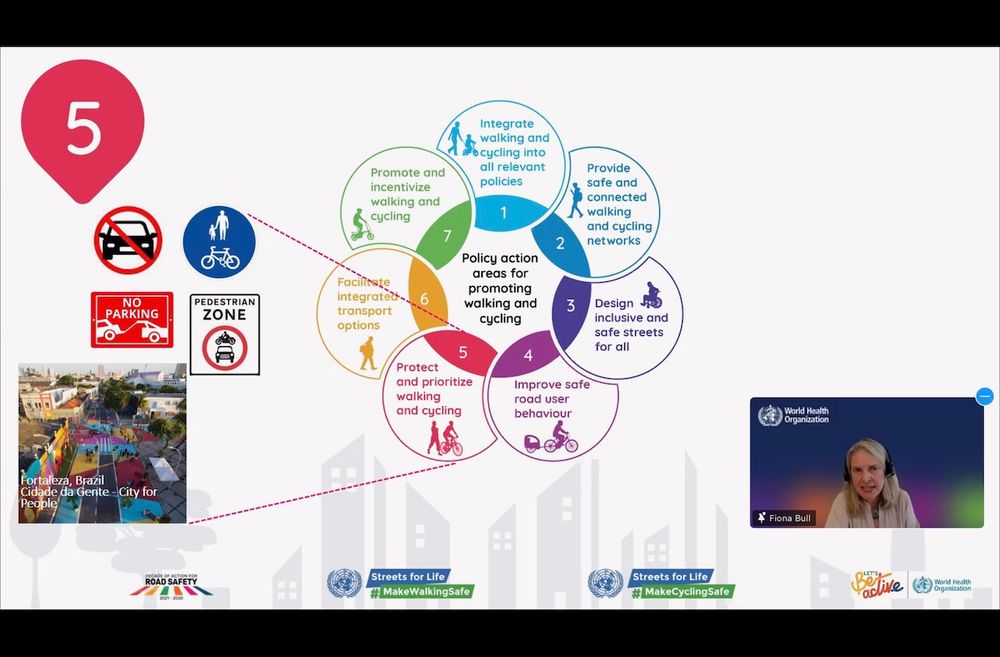
Screenshot showing Prof Fiona Bull from WHO describing the seven policy action areas in the toolkit: 1. Integrate walking and cycling into all relevant policies Embed walking and cycling objectives across transport, health, environment, education, and tourism policies. Establish clear, measurable targets and crossgovernment coordination mechanisms. 2. Provide safe and connected walking and cycling networks Develop well-connected, well-maintained infrastructure that links homes to key destinations (e.g. schools, transit, workplaces). Integrate green spaces and apply inclusive and sustainable urban design principles. 3. Design inclusive and safe streets for all Use human-centred design principles to create streets that accommodate all users, including pedestrians and cyclists of all ages and abilities. Implement safe system approach to improve road safety including best practice legislation to reduce speed limits where necessary. 4. Improve safe road user behaviour Enforce speed limits, tackle distracted and impaired driving, and promote safe use by all road users. 5. Protect and prioritize walking and cycling Create, maintain and protect allocation of road space to walking and cycling, implement pedestrian zones, and enforce parking regulations. 6. Facilitate integrated transport options Ensure walking and cycling are part of a seamless transport experience through integration with public transport and shared mobility services. 7. Promote and incentivize walking and cycling Create a culture of walking and cycling through communication campaigns, events, financial incentives, and workplace and school programmes.
Excellent @who.int webinar launching their impressive new toolkit for promoting walking and cycling.
www.who.int/publications...
Great to hear mention of the WHO HEAT tool during the discussion.
www.who.int/tools/heat-f...
This is worth unpicking further. "Turning parkrun into a prescription makes it less about pleasure and fun, more like work and compliance". I suspect many park runners are already ambivalent; duty/duress/need/extrinsic motivation to maintain health goals. Status quo isn't all pleasure and fun.
09.04.2025 12:06 — 👍 3 🔁 0 💬 1 📌 0